Individual, interpersonal and sociocultural contributors to maths anxiety in children
Click the buttons to download the infographic and transcript!
Title
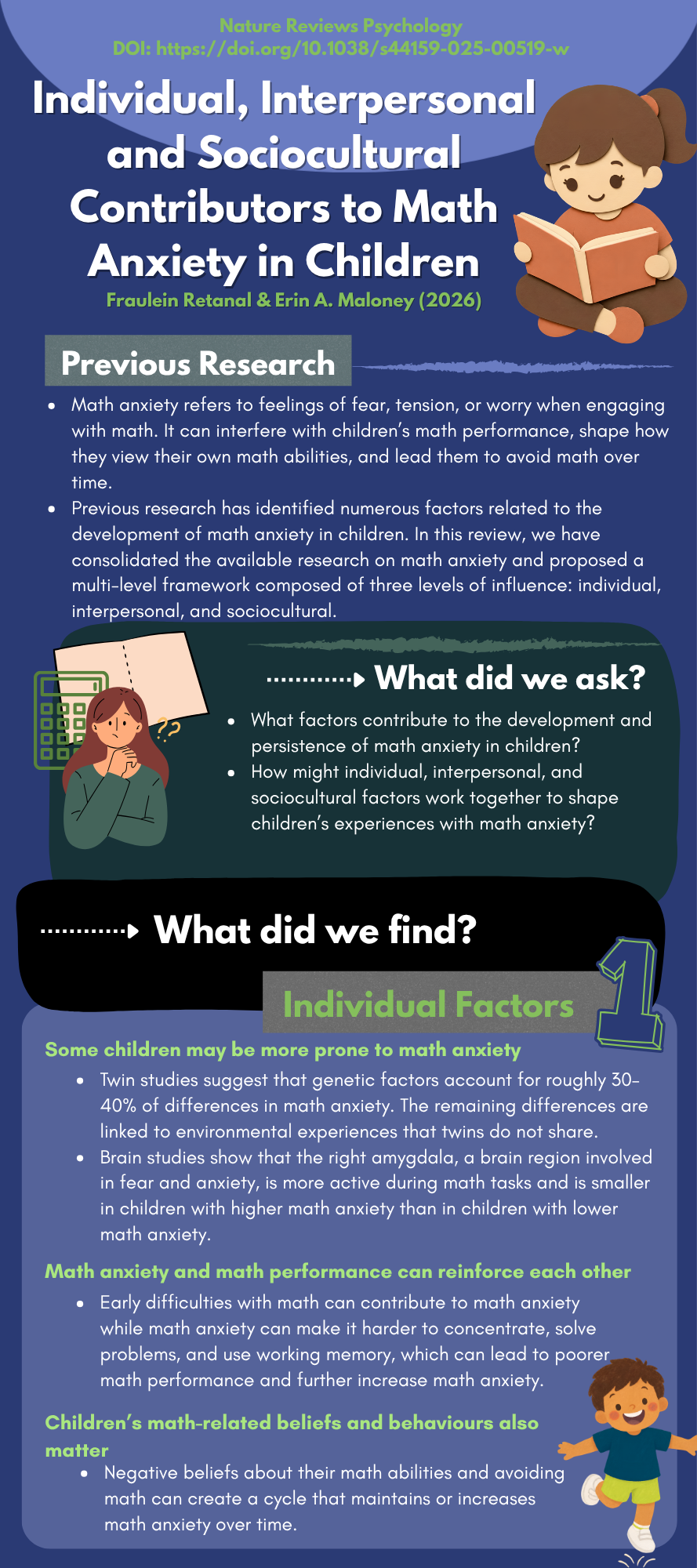
Individual, interpersonal and sociocultural contributors to math anxiety in children
Authors
Fraulein Retanal & Erin A. Maloney (2026)
Journal and DOI
- Nature Reviews Psychology
Previous Research
- Math anxiety refers to feelings of fear, tension, or worry when engaging with math. It can interfere with children’s math performance, shape how they view their own math abilities, and lead them to avoid math over time.
- Previous research has identified numerous factors related to the development of math anxiety in children. In this review, we have consolidated the available research on math anxiety and proposed a multi-level framework composed of three levels of influence: individual, interpersonal, and sociocultural.
What did we ask?
- What factors contribute to the development and persistence of math anxiety in children?
- How might individual, interpersonal, and sociocultural factors work together to shape children’s experiences with math anxiety?
What did we find?
Individual Factors
- Some children may be more prone to math anxiety
- Twin studies suggest that genetic factors account for roughly 30–40% of differences in math anxiety. The remaining differences are linked to environmental experiences that twins do not share.
- Brain studies show that the right amygdala, a brain region involved in fear and anxiety, is more active during math tasks and is smaller in children with higher math anxiety than in children with lower math anxiety.
- Math anxiety and math performance can reinforce each other.
- Early difficulties with math can contribute to math anxiety while math anxiety can make it harder to concentrate, solve problems, and use working memory, which can lead to poorer math performance and further increase math anxiety.
- Children’s math-related beliefs and behaviours also matter.
- Negative beliefs about their math abilities and avoiding math can create a cycle that maintains or increases math anxiety over time.
Interpersonal Factors
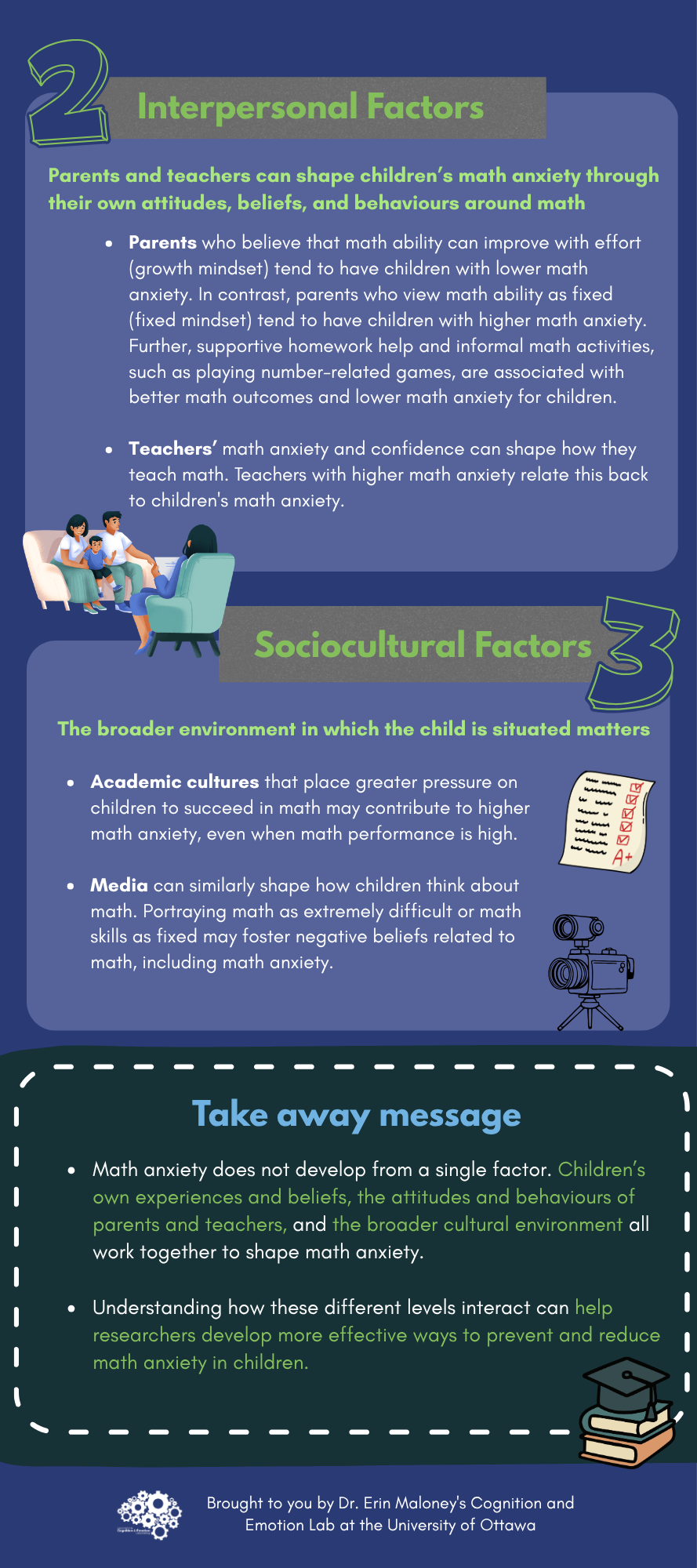
- Parents and teachers can shape children’s math anxiety through their own attitudes, beliefs, and behaviours around math.
- Parents who believe that math ability can improve with effort (growth mindset) tend to have children with lower math anxiety. In contrast, parents who view math ability as fixed (fixed mindset) tend to have children with higher math anxiety. Further, supportive homework help and informal math activities, such as playing number-related games, are associated with better math outcomes and lower math anxiety for children.
- Teachers’ math anxiety and confidence can shape how they teach math. Teachers with higher math anxiety relate this back to children’s math anxiety.
Sociocultural Factors
- The broader environment in which the child is situated matters.
- Academic cultures that place greater pressure on children to succeed in math may contribute to higher math anxiety, even when math performance is high.
- Media can similarly shape how children think about math. Portraying math as extremely difficult or math skills as fixed may foster negative beliefs related to math, including math anxiety.
Take away message
- Math anxiety does not develop from a single factor. Children’s own experiences and beliefs, the attitudes and behaviours of parents and teachers, and the broader social and cultural environment all work together to shape math anxiety.
- Understanding how these different levels interact can help researchers develop more effective ways to prevent and reduce math anxiety in children.
Brought to you by Dr. Erin Maloney’s Cognition and Emotion Lab at the University of Ottawa.

