Numerical Comparison Is Spatial – Except When It is Not
Click the buttons to download the infographic and transcript!
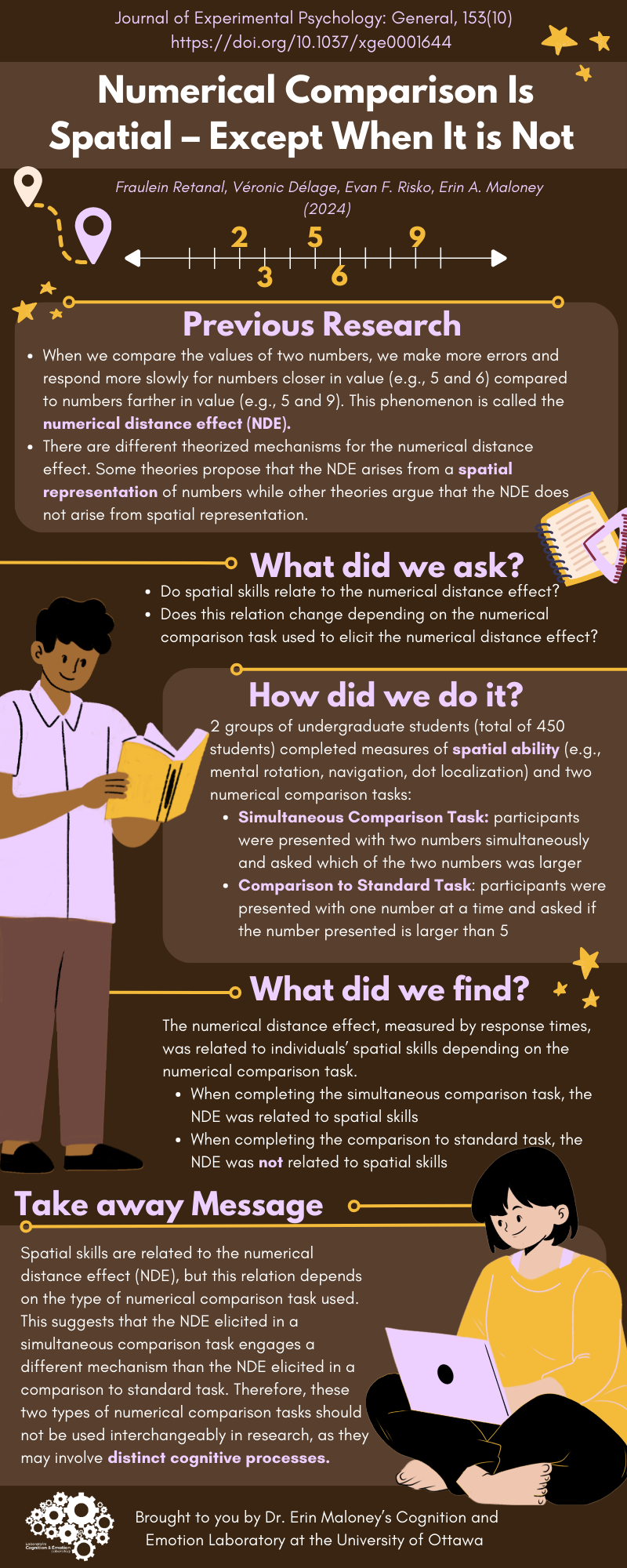
Title
- Numerical Comparison Is Spatial – Except When It is Not
Authors
- Fraulein Retanal, Véronic Délage, Evan F. Risko, Erin A. Maloney (2024)
Journal and DOI
- Journal of Experimental Psychology: General, 153(10)
- DOI: https://doi.org/10.1037/xge0001644
Previous Research
- When we compare the values of two numbers, we make more errors and respond more slowly for numbers closer in value (e.g., 5 and 6) compared to numbers farther in value (e.g., 5 and 9). This phenomenon is called the numerical distance effect (NDE).
- There are different theorized mechanisms for the numerical distance effect. Some theories propose that the NDE arises from a spatial representation of numbers while other theories argue that the NDE does not arise from spatial representation.
What did we ask?
- Do spatial skills relate to the numerical distance effect?
- Does this relation change depending on the numerical comparison task used to elicit the numerical distance effect?
How did we do it?
- 2 groups of undergraduate students (total of 450 students) completed measures of spatial ability (e.g., mental rotation, navigation, dot localization) and two numerical comparison tasks:
- Simultaneous Comparison Task: participants were presented with two numbers simultaneously and asked which of the two numbers was larger
- Comparison to Standard Task: participants were presented with one number at a time and asked if the number presented is larger than 5
What did we find?
- The numerical distance effect, measured by response times, was related to individuals’ spatial skills depending on the numerical comparison task.
- When completing the simultaneous comparison task, the NDE was related to spatial skills
- When completing the comparison to standard task, the NDE was not related to spatial skills
Take away Message
- Spatial skills are related to the numerical distance effect (NDE), but this relation depends on the type of numerical comparison task used. This suggests that the NDE elicited in a simultaneous comparison task engages a different mechanism than the NDE elicited in a comparison to standard task. Therefore, these two types of numerical comparison tasks should not be used interchangeably in research, as they may involve distinct cognitive processes.
Brought to you by Dr. Erin Maloney’s Cognition and Emotion Lab at the University of Ottawa.
 Cognition & Emotion Lab
