Development of children’s number line estimation in primary school: Regional and curricular influences
Click the buttons to download the infographic and transcript!
Title
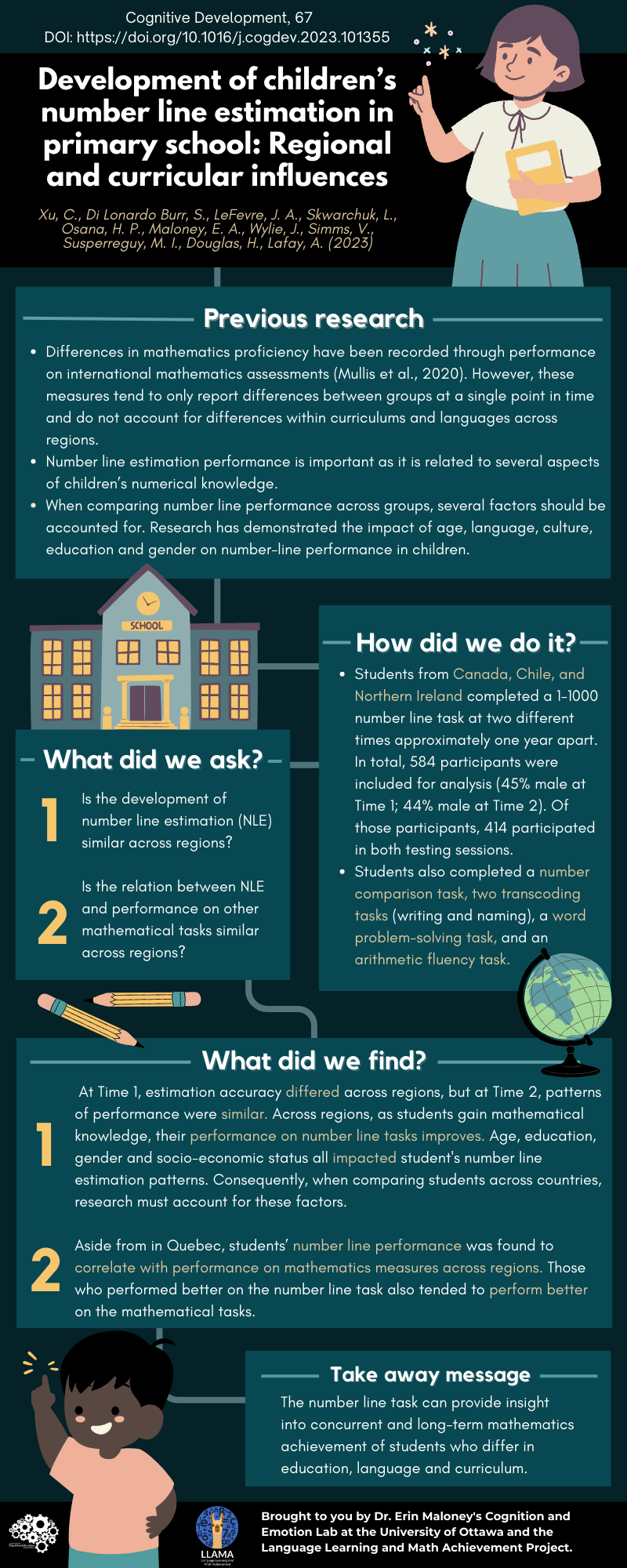
- Development of children’s number line estimation in primary school: Regional and curricular influences
Authors
- Xu, C., Di Lonardo Burr, S., LeFevre, J. A., Skwarchuk, L., Osana, H. P., Maloney, E. A., Wylie, J., Simms, V., Susperreguy, M. I., Douglas, H., Lafay, A. (2023)
Journal and DOI
- Journal: Cognitive Development, 67
- DOI: https://doi.org/10.1016/j.cogdev.2023.101355
Previous Research
- Differences in mathematics proficiency have been recorded through performance on international mathematics assessments (Mullis et al., 2020). However, these measures tend to only report differences between groups at a single point in time and do not account for differences within curriculums and languages across regions.
- Number line estimation performance is important as it is related to several aspects of children’s numerical knowledge.
- When comparing number line performance across groups, several factors should be accounted for. Research has demonstrated the impact of age, language, culture, education and gender on number-line performance in children.
What did we ask?
- Research Question 1: Is the development of number line estimation (NLE) similar across regions?
- Research Question 2: Is the relation between NLE and performance on other mathematical tasks similar across regions?
How did we do it?
- Students from Canada, Chile, and Northern Ireland completed a 1-1000 number line task at two different times approximately one year apart. In total, 584 participants were included for analysis (45% male at Time 1; 44% male at Time 2). Of those participants, 414 participated in both testing sessions.
- Students also completed a number comparison task, two transcoding tasks (writing and naming), a word problem-solving task, and an arithmetic fluency task.
What did we find?
- Research Question 1: At Time 1, estimation accuracy differed across regions, but at Time 2, patterns of performance were similar. Across regions, as students gain mathematical knowledge, their performance on number line tasks improves. Age, education, gender and socio-economic status all impacted student’s number line estimation patterns. Consequently, when comparing students across countries, research must account for these factors.
- Research Question 2: Aside from in Quebec, students’ number line performance was found to correlate with performance on mathematics measures across regions. Those who performed better on the number line task also tended to perform better on the mathematical tasks.
Take away Message
- The number line task can provide insight into concurrent and long-term mathematics achievement of students who differ in education, language and curriculum.
Brought to you by Dr. Erin Maloney’s Cognition and Emotion Lab at the University of Ottawa.
 Cognition & Emotion Lab