What’s Math Got to Do with It?: Establishing Nuanced Relations between Math Anxiety, Financial Anxiety, and Financial Literacy
Click the buttons to download the infographic and transcript!
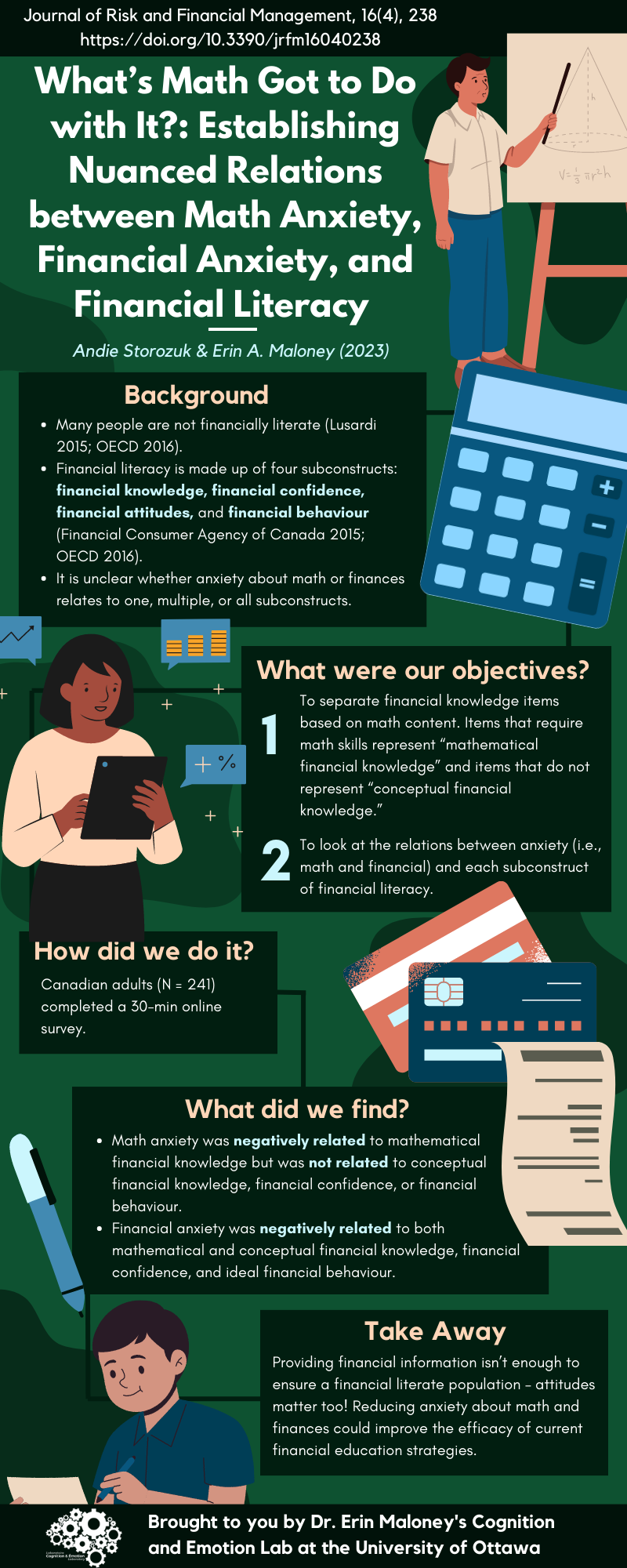
Title
- What’s Math Got to Do with It?: Establishing Nuanced Relations between Math Anxiety, Financial Anxiety, and Financial Literacy
Authors
- Andie Storozuk & Erin A. Maloney (2023)
Journal and DOI
- Journal of Risk and Financial Management, 16(4), 238
- https://doi.org/10.3390/jrfm16040238
Background
- Many people are not financially literate (Lusardi 2015; OECD 2016).
- Financial literacy is made up of four subconstructs: financial knowledge, financial confidence, financial attitudes, and financial behaviour (Financial Consumer Agency of Canada 2015; OECD 2016).
- It is unclear whether anxiety about math or finances relates to one, multiple, or all subconstructs.
What were our objectives?
- Objective 1: To separate financial knowledge items based on math content. Items that require math skills represent “mathematical financial knowledge” and items that do not represent “conceptual financial knowledge.”
- Objective 2: To look at the relations between anxiety (i.e., math and financial) and each subconstruct of financial literacy.
How did we do it?
- Canadian adults (N = 241) completed a 30-min online survey.
What did we find?
- Math anxiety was negatively related to mathematical financial knowledge but was not related to conceptual financial knowledge, financial confidence, or financial behaviour.
- Financial anxiety was negatively related to both mathematical and conceptual financial knowledge, financial confidence, and ideal financial behaviour.
Take Away
- Providing financial information isn’t enough to ensure a financial literate population – attitudes matter too! Recuing anxiety about math and finances could improve the efficacy of current financial education strategies.
Brought to you by Dr. Erin Maloney’s Cognition and Emotion Lab at the University of Ottawa.
 Cognition & Emotion Lab