Next Directions in Measurement of the Home Mathematics Environment: An International and Interdisciplinary Perspective
Click the buttons to download the infographic and transcript!
Title:
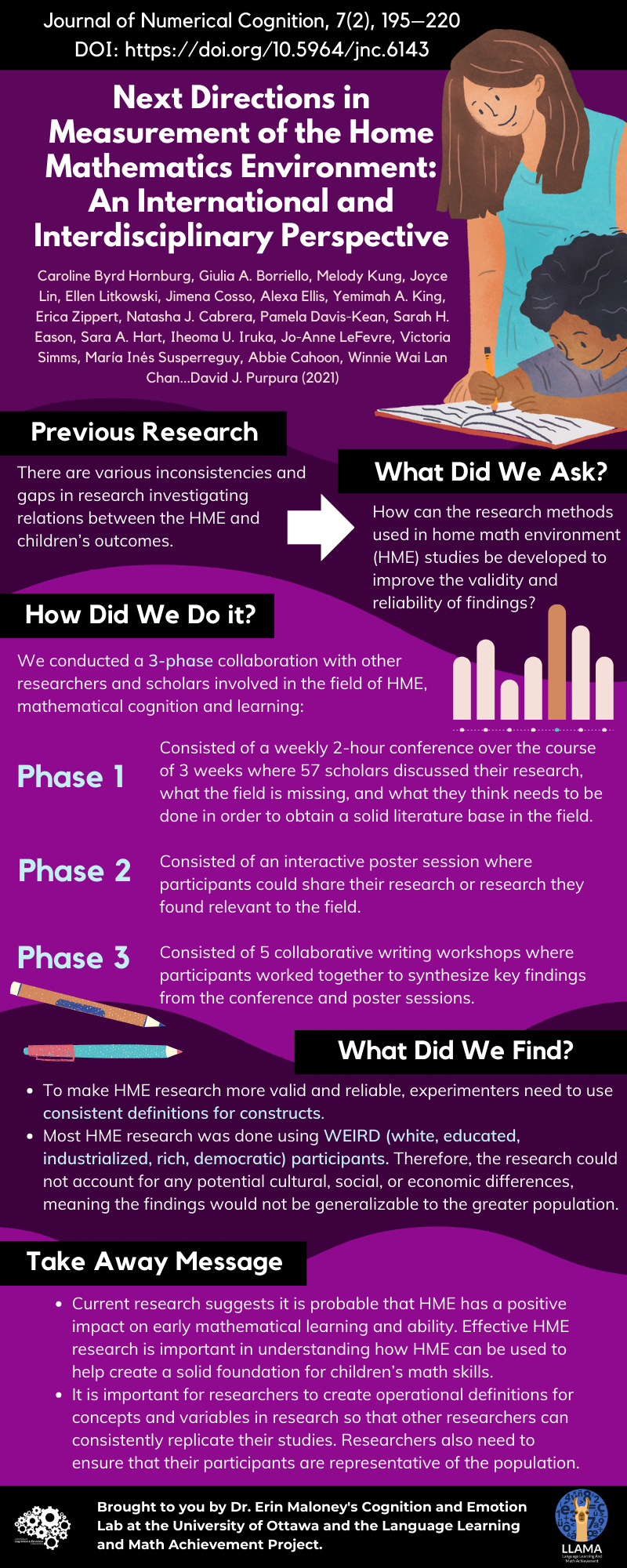
Next Directions in Measurement of the Home Mathematics Environment: An International and Interdisciplinary Perspective
Authors:
Caroline Byrd Hornburg, Giulia A. Borriello, Melody Kung, Joyce Lin, Ellen Litkowski, Jimena Cosso, Alexa Ellis, Yemimah A. King, Erica Zippert, Natasha J. Cabrera, Pamela Davis-Kean, Sarah H. Eason, Sara A. Hart, Iheoma U. Iruka, Jo-Anne LeFevre, Victoria Simms, María Inés Susperreguy, Abbie Cahoon, Winnie Wai Lan Chan…David J. Purpura (2021)
Journal and DOI:
Journal: Journal of Numerical Cognition, 7(2), 195–220
DOI: https://doi.org/10.5964/jnc.6143
Previous Research
There are various inconsistencies and gaps in research investigating relations between the HME and children’s outcomes.
What Did We Ask?
How can the research methods used in home math environment (HME) studies be developed to improve the validity and reliability of findings?
How Did We Do it?
We conducted a 3-phase collaboration with other researchers and scholars involved in the field of HME, mathematical cognition and learning:
Phase 1 consisted of a weekly 2-hour conference over the course of 3 weeks where 57 scholars discussed their research, what the field is missing, and what they think needs to be done in order to obtain a solid literature base in the field.
Phase 2 consisted of an interactive poster session where participants could share their research or research they found relevant to the field.
Phase 3 consisted of 5 collaborative writing workshops where participants worked together to synthesize key findings from the conference and poster sessions.
What Did We Find?
To make HME research more valid and reliable, experimenters need to use consistent definitions for constructs.
Most HME research was done using WEIRD (white, educated, industrialized, rich, democratic) participants. Therefore, the research could not account for any potential cultural, social, or economic differences, meaning the findings would not be generalizable to the greater population.
Take Away Message
Current research suggests it is probable that HME has a positive impact on early mathematical learning and ability. Effective HME research is important in understanding how HME can be used to help create a solid foundation for children’s math skills.
It is important for researchers to create operational definitions for concepts and variables in research so that other researchers can consistently replicate their studies. Researchers also need to ensure that their participants are representative of the population.
Brought to you by Dr. Erin Maloney’s Cognition and Emotion Lab at the University of Ottawa.
 Cognition & Emotion Lab