It’s a “Small World”: Relations between performance on five spatial tasks and five mathematical tasks in undergraduate students
Click the buttons to download the infographic and transcript!
Title
It’s a “Small World”: Relations between performance on five spatial tasks and five mathematical tasks in undergraduate students
Authors
· Véronic Delage, Richard J. Daker, Geneviève Trudel, Ian M. Lyons, Erin A. Maloney (2024)
Journal and DOI
· Canadian Journal of Experimental Psychology
· https://doi.org/10.3390/jintelligence12030030
Previous Research
· Spatial reasoning: mentally visualizing, rotating, and transforming visuospatial information.
· People who are good at spatial reasoning also tend to be good at mathematical reasoning. People who are good at spatial reasoning also tend to be good at mathematical reasoning.
· Research has generated two ideas as to why this is:
- General: numbers in general are processed in a spatial way
- Specific: some spatial reasoning tasks are uniquely related to some mathematical reasoning tasks
What did we ask?
· If we look at multiple different spatial reasoning tasks and mathematical reasoning tasks, can we see if some (rather than all) spatial tasks are related to some (rather than all) math tasks? If so, which tasks are related?
How did we do it?
· Two groups of undergraduate students (total of 755 students) completed mathematical reasoning tasks according to Ontario’s math curriculum (e.g., algebra, data management and probability etc.), and five spatial reasoning tasks according to past research (e.g., mental rotation, navigation, etc.).
· We looked at how students’ performances on the 10 different tasks relate to one another and form groups of tasks.
What did we find?
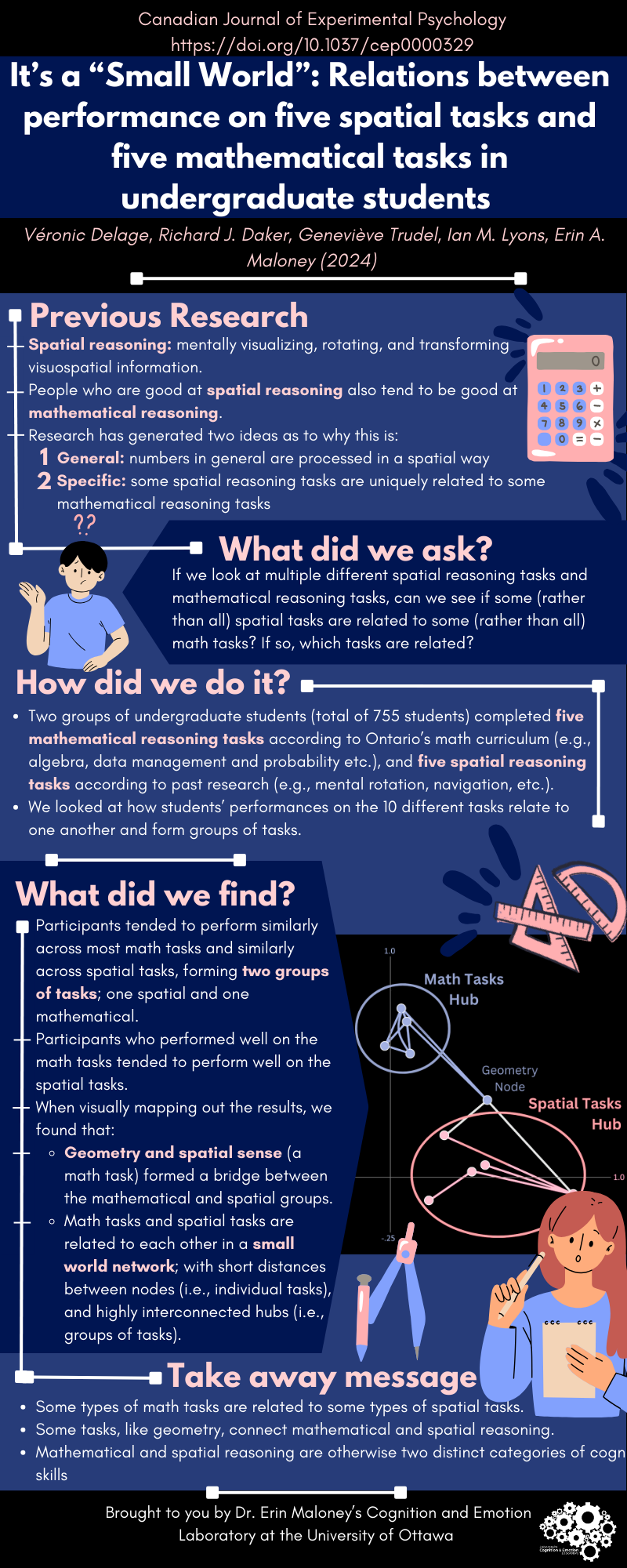
· Participants tended to perform similarly across most math tasks and similarly across spatial tasks, forming two groups of tasks; one spatial and one mathematical.
· Participants who performed well on the math tasks tended to perform well on the spatial tasks.
· When visually mapping out the results, we found that:
- · Geometry and spatial sense (a math task) formed a bridge between the mathematical and spatial groups.
- · Math tasks and spatial tasks are related to each other in a small world network; with short distances between nodes (i.e., individual tasks), and highly interconnected hubs (i.e., groups of tasks).
Textual description of the image included in this infographic: A scatterplot graph with two clusters of data. One cluster of four interconnected data points in light blue is labelled “Math Tasks Hub”. The other cluster of five interconnected data points in pink is labelled “Spatial Tasks Hub”. Two data points on each hub connect to a blue data point, representing a math task, that falls outside the two hubs, labelled “Geometry Node”.
Take away Message
· Some types of math tasks are related to some types of spatial tasks.
· Some tasks, like geometry, connect mathematical and spatial reasoning.
· Mathematical and spatial reasoning are otherwise two distinct categories of cognitive skills
Brought to you by Dr. Erin Maloney’s Cognition and Emotion Lab at the University of Ottawa.
 Cognition & Emotion Lab