Examining the interplay between the cognitive and emotional aspects of gender differences in spatial processing
Click the buttons to download the infographic and transcript!
Title
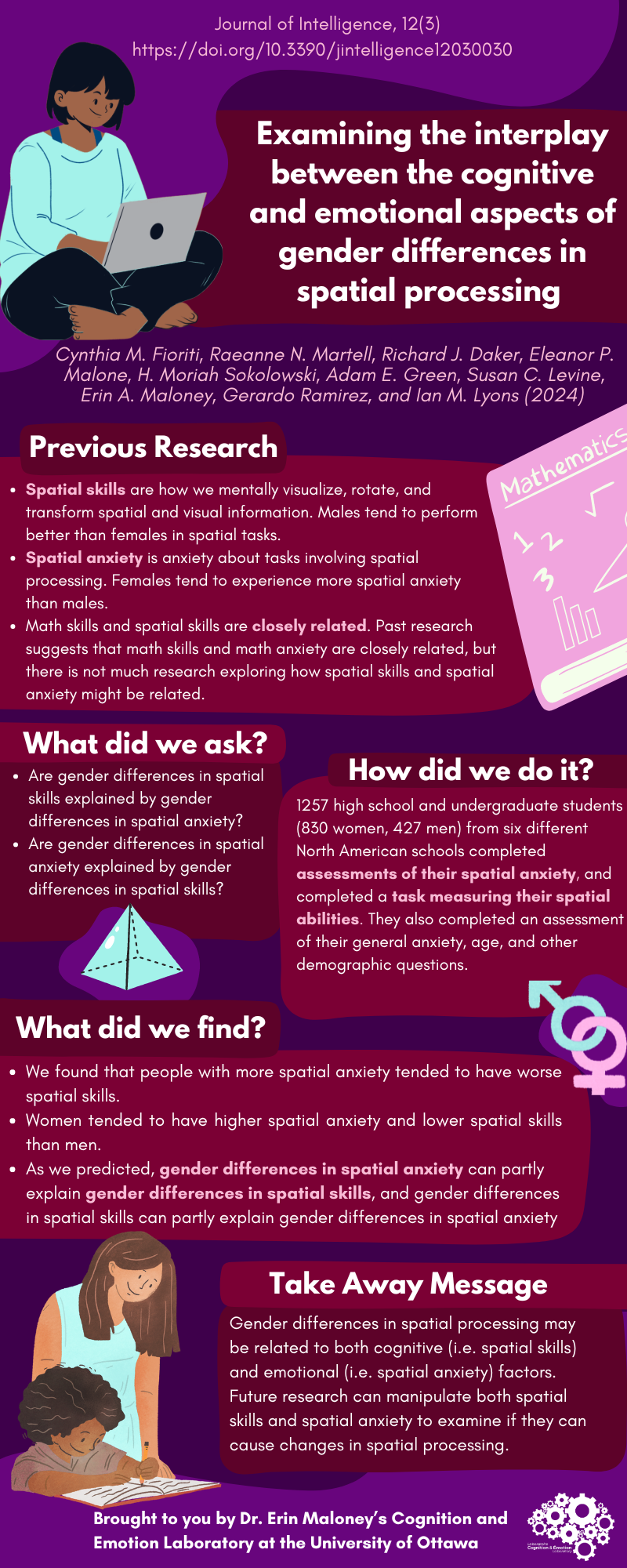
Examining the interplay between the cognitive and emotional aspects of gender differences in spatial processing
Authors
· Cynthia M. Fioriti, Raeanne N. Martell, Richard J. Daker, Eleanor P. Malone, H. Moriah Sokolowski, Adam E. Green, Susan C. Levine, Erin A. Maloney, Gerardo Ramirez, and Ian M. Lyons (2024)
Journal and DOI
· Journal of Intelligence
· https://doi.org/10.3390/jintelligence12030030
Previous Research
· Spatial skills are how we mentally visualize, rotate, and transform spatial and visual information. Males tend to perform better than females in spatial tasks.
· Spatial anxiety is anxiety about tasks involving spatial processing. Females tend to experience more spatial anxiety than males.
· Math skills and spatial skills are closely related. While past research suggests that math skills and math anxiety are also closely related, there is not much research exploring how spatial skills and spatial anxiety might be linked.
What did we ask?
· Are gender differences in spatial skills explained by gender differences in spatial anxiety?
· Are gender differences in spatial anxiety explained by gender differences in spatial skills?
How did we do it?
· 1257 high school and undergraduate students (830 women, 427 men) from six different North American schools completed assessments of their spatial anxiety, and completed a task measuring their spatial abilities. They also completed an assessment of their general anxiety, age, and other demographic questions.
What did we find?
· We found that people with more spatial anxiety tended to have worse spatial skills. Women tended to have higher spatial anxiety and lower spatial skills than men. As we predicted, gender differences in spatial anxiety can partly explain gender differences in spatial skills, and gender differences in spatial skills can partly explain gender differences in spatial anxiety.
Take away Message
· Gender differences in spatial processing may be related to both cognitive (i.e. spatial skills) and emotional (i.e. spatial anxiety) factors. Future research can manipulate both spatial skills and spatial anxiety to examine if they can cause changes in spatial processing.
Brought to you by Dr. Erin Maloney’s Cognition and Emotion Lab at the University of Ottawa.
 Cognition & Emotion Lab